- Initiative: Other
Audrey G. Ratner Speaker Series
Audrey G. Ratner Lecture
Rottman Family Lecture
In December 2020, Colonel (IL) Jennifer N. Pritzker, IL ARNG (Retired) facilitated a gift commitment of $1,000,000 over five years from the TAWANI Foundation to establish the Audrey G. Ratner Excellence Endowed Fund for American Jewry and Jewish Culture. Additionally, the TAWANI Foundation agreed to match, dollar for dollar, over a period of five years, private cash and stock donations received by Tulane in support of the Audrey G. Ratner Excellence Endowed Fund, for a total of up to $1,000,000. The TAWANI Foundation gift is made in honor of Audrey Gilbert Ratner, the matriarch of the Ratner-Pritzker families. Ms. Ratner is mother to Jennifer, and grandmother to both Andrew Pritzker and Emily Ratner. Ms. Ratner selected Tulane to be the recipient of this honorary gift from her daughter Jennifer to honor her grandchildren’s education and continued involvement at Tulane.
The Audrey G. Ratner Excellence Endowed Fund for American Jewry and Jewish Culture supports a dynamic slate of action-oriented programming goals, innovative student engagement activities, and cutting edge research, educating Tulane students for the transformative purpose of becoming the forward-thinking Jewish leaders of tomorrow. To accomplish this goal, the endowment will support key initiatives and programs. Students will have opportunities to cultivate leadership skills through structured academic experiences: the Audrey G. Ratner Jewish Leadership Course and Student Faculty Research Funds.
The Ratner Speaker Series supports lectures, roundtables, and films and could bring internationally renowned speakers to Tulane University. Our participants—artists, scholars, public intellectuals, communal leaders—will contribute to a robust conversation about American Jewish culture, history, and ideas, to which the entire Tulane community would be invited. Ratner Speakers will also meet with student leaders at Hillel, connecting their academic work with our community and offering another area where student leaders could experience life-changing growth in their personal understanding and relationship to Judaism and Judaic culture.
"Antisemitism, An American Tradition" Book Talk with Dr. Pamela Nadell
From the arrival of Jews in New Amsterdam in 1654 to the present day, Nadell traces nearly four centuries of antisemitism in the United States in her book, “Antisemitism, An American Tradition”—how it took root, how it has shaped Jewish life, and how Jews have continually resisted prejudice through advocacy, law, and coalition-building. At a moment of rising hate, this book reminds us why understanding this history matters.
Pamela S. Nadell holds the Patrick Clendenen Chair in Women’s and Gender History and is Director of the Jewish Studies Program. A specialist in American Jewish history and women’s history, she teaches a variety of courses in Jewish civilization. Her awards include AU’s highest faculty award, Scholar/Teacher of the Year (2007). Pamela Nadell’s books include America’s Jewish Women: A History from Colonial Times to Today (W.W. Norton, 2019), named Jewish Book of the Year by the Jewish Book Council. Reviewed in the New York Times, America’s Jewish Women was praised as “a welcome addition to the American historical canon.” Past president of the Association for Jewish Studies, Nadell’s other titles include Women Who Would Be Rabbis: A History of Women’s Ordination, 1889–1985 (Beacon Press, 1998). She consults for museums including the National Museum of American Jewish History and the Milken Center for Advancing the American Dream. She lectures widely, frequently appears on podcasts, and has written for, among others, the Washington Post, The Conversation, and Hadassah Magazine. In 2017, she testified before Congress about antisemitism on college campuses.
Jewish Stories of Katrina: Why They Matter 20 Years Later with Dr. Karla Goldman
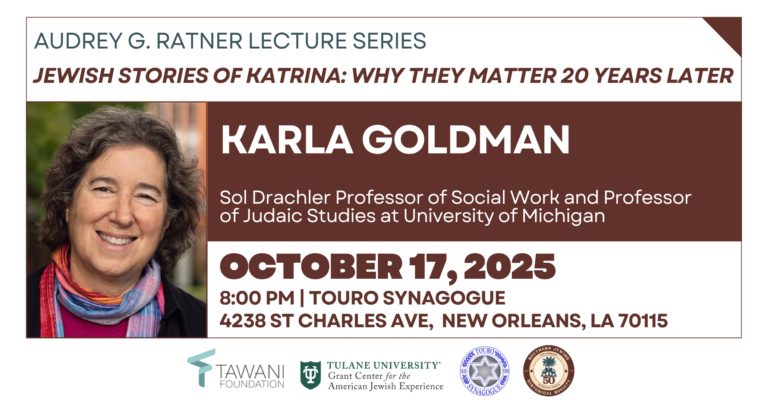
“The hundreds of thousands of individual stories of displacement, despair, resilience, and survival left behind by Hurricane Katrina shine a rare spotlight on the communities and relationships in which we live and find meaning. Not surprisingly, it is the most desperate stories of abandonment experienced by the most impoverished populations of New Orleans and the massive governmental failure to respond effectively to the crisis that have become central to our collective understanding of the storm’s impact and significance.
What follows is a brief exploration of some of the themes that shaped the Jewish experiences of Katrina, as reflected in the words of the some of the 85 narrators who participated in the Katrina’s Jewish Voices Oral History Project, conducted by the Jewish Women’s Archive (where Karla worked from 2000 to 2008 as historian in residence) and the Institute for Southern Jewish Life. The answer, perhaps, to the question of why we should preserve these stories comes in the stories themselves.”
A Credit to the Nation: The Lost World of Eastern European Jewish Immigrant 'Bankers,' 1873-1930 with Dr. Rebecca Kobrin
How different would the central narrative of American Jewish immigration history sound if we invited its commercial practices to center stage? Between 1870 and 1930 thousands of East European Jewish immigrant businessmen set up financial enterprises called immigrant banks that not only shaped mass Jewish migration from Eastern Europe but American finance as well. Using an interdisciplinary approach that draws on court cases, the foreign language press, business records, and memoirs, my talk highlights the central role East European Jewish immigrant entrepreneurs played on both sides of the Atlantic. Offering credit to prospective migrants by selling them ship tickets on installment, these immigrant businessmen embedded East European migrants in a larger system of distribution and established them as lucrative commodities. Once these migrants settled in their new homes, these entrepreneurs continued to offer them credit for business ventures and real estate investment, as more established banks refused to address their financial needs. In doing so, they not only aided in Jewish immigrant adaptation but left an indelible imprint on New York City’s development and industries.
In Each and Every Generation: Survivors and Their Descendants with Dr. David Slucki
It is perhaps obvious today to say that the Holocaust left a lasting impact on survivors and their descendants, that they have experienced trauma, isolation, and struggled with what it means to carry the Holocaust legacy. But it wasn’t always so obvious. In this talk, Dr. David Slucki examines the long-term impact of the Holocaust on survivors, and their children and grandchildren and how the ways we think about these impacts have changed over time and generations. In looking at the stories and scholarship on survivors and their descendants, Dr. Slucki investigate how each of these generations has integrated knowledge of the Holocaust into their lives, on an individual, familial, and communal level. Scholars across a range of fields, particularly history, psychology, and literary studies, have long debated how or whether trauma is transmitted, how the Holocaust changed what it means to be Jewish, or what the Jewish family might look like in the wake of the destruction of Jewish families. But there has never been a settled answer and we still continue to grapple with how the Holocaust has changed our lives and what is the best way to remember it and understand its impact. This event was in conversation with the Grant Center’s Dr. Michael Cohen.
Ballots, Babies, and Banners of Peace: American Jewish Women's Activism with Dr. Melissa Klapper
This talk with Dr. Melissa Klapper explored the social and political activism of American Jewish women from the 1890s through World War II, focusing on three mass women’s movements of the day: suffrage, birth control, and peace. No history of first wave feminism is complete without understanding the outsize impact of Jewish women on these movements and the powerful effect of their activism on contemporary American life.
Kosher Soul: Black Jewish Identity Cooking with Michael W. Twitty
Michael W. Twitty is an award-winning culinary historian and food writer. His 2017 book, “The Cooking Gene,” traced his ancestry through food from Africa to America and from slavery to freedom and won the 2018 James Beard Award for writing.
In this lecture, Michael W. Twitty considered the marriage of two of the most distinctive culinary cultures in the world today: the foods and traditions of the African Atlantic and the global Jewish diaspora. “Kosher Soul,” his follow up to “The Cooking Gene,” was published in 2022 through HarperCollins.
Jews in the United States and the Response to the Holocaust, 1942-1945 with Dr. Jason Dawsey
Reports of the mass murder of European Jews reached Jews in the United States in 1942. Although precise knowledge of what was actually happening was piecemeal, American Jews and Jewish refugees, recently arrived in the US, mobilized to draw attention to the genocide, demanded military action against the Nazis to stop the killing, and called for collective efforts to aid survivors. This talk covers the range of responses from the Jewish community in the US to the Holocaust during World War II.
Participating Scholars
Melissa R. Klapper
-
Rowan University
Jason Dawsey
-
The National WWII Museum
Michael W. Twitty
Laura Arnold Leibman
-
Reed College
Sandra Fox
-
New York University
Hilary Klotz Steinman
Paul Root Wolpe
-
Emory University